

Rwanda’s economy produced about 16.4 billion dollars in 2025 and grew 9.4 percent that year, according to official figures. Growth looks strong on paper. Services and construction helped. Yet the same years left the country with heavy debts to the World Bank and the International Monetary Fund.
As of mid-2026 total public and publicly guaranteed debt stood near 12.2 billion dollars, roughly 69 percent of GDP. Most of it is external. The World Bank remains the biggest single multilateral lender, with several billion dollars outstanding. IMF credit sits around 800 million dollars. Debt service already takes a large share of government revenue. Every dollar or franc spent on repayments is money not available for schools, clinics or farm support.
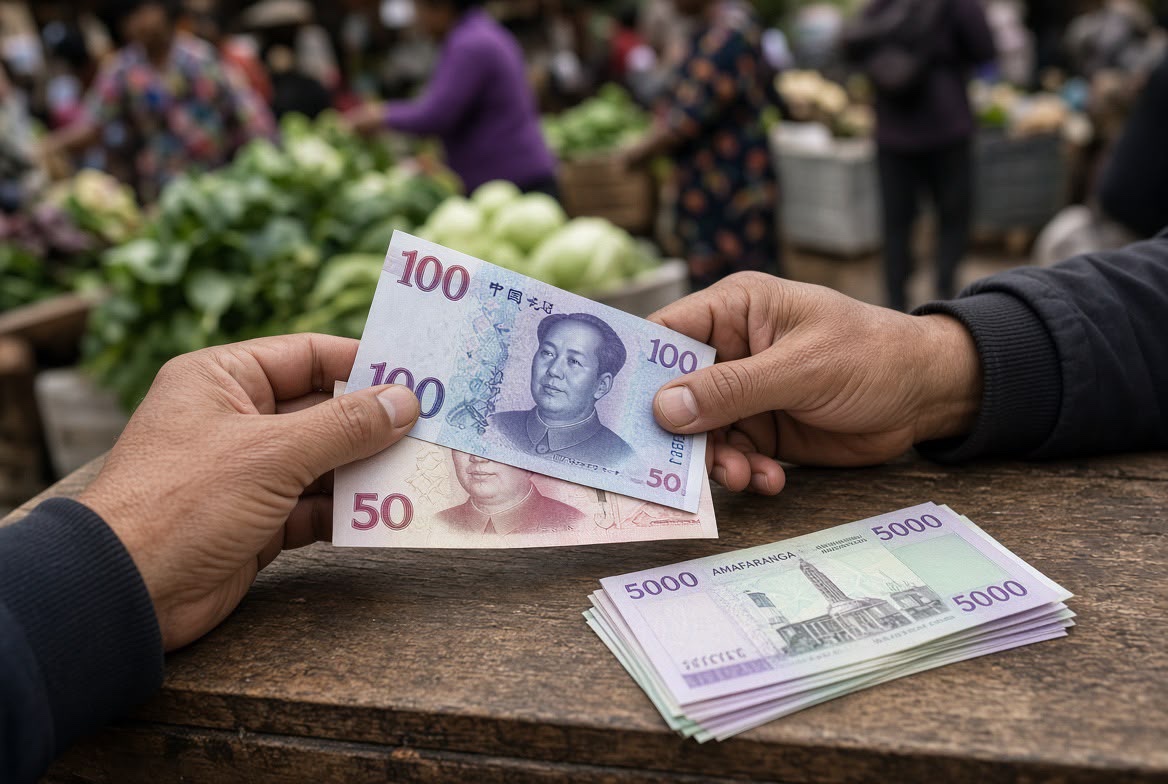
In late 2026 the United States sanctioned the Rwandan Ministry of Defence and Zigama Credit and Savings Society over support for the M23 armed group in eastern Congo. Those measures block certain dollar transactions linked to the named entities. They do not cut Rwanda off from the entire dollar system, and the country continues to receive IMF disbursements. Still, officials have tightened rules on dollar use inside the country and have deepened links with China. Bank of Kigali joined China’s yuan payment system. China is already Rwanda’s top source of imports.
Moving more trade or future borrowing toward the yuan can reduce reliance on the dollar and cut some conversion costs with Chinese partners. It can also open new credit lines. Those are the stated benefits. The costs are less discussed. Yuan liquidity is thinner. Sudden shifts can make it harder for importers to buy fuel, fertiliser or spare parts that are still priced in dollars. Currency mismatches raise the risk that debt servicing becomes more expensive if the franc weakens further against either currency. Over-dependence on any single foreign currency, whether dollar or yuan, leaves the country exposed to decisions made in Washington or Beijing.
Ordinary Rwandans already feel the pressure
Urban inflation reached 19.5 percent year-on-year in October 2026. National inflation hit 26.5 percent. In rural areas it was higher still, around 31 percent. Food prices rose nearly 29 percent in cities and far more in villages. Vegetables, the staple of daily meals, climbed sharply. A market trader in Kigali or a farmer selling beans in the hills now watches the same basket of goods cost almost a third more than a year earlier. Wages and small profits have not kept pace. Families cut meals, delay medical care or pull children from school fees. Debt repayments that consume public money make it harder for the state to cushion these rises with subsidies or social transfers.
Pro-government newspapers and radio stations rarely spell this out. They lead with growth percentages and new infrastructure. They treat rising prices as temporary external shocks and present every loan conversion or Chinese partnership as pure progress. Questions about how much ordinary households lose when food doubles, or how sanctions and currency experiments affect small businesses, stay off the air. Independent voices that try to report the full picture face pressure. The gap between official headlines and the empty market stalls is wide.
The numbers on GDP and debt are public. The empty pockets and higher market prices are visible every day. Until the cost of servicing those World Bank and IMF loans, and the risks of any currency pivot, are measured against the real burden on families who buy food by the kilo, the story remains incomplete.