
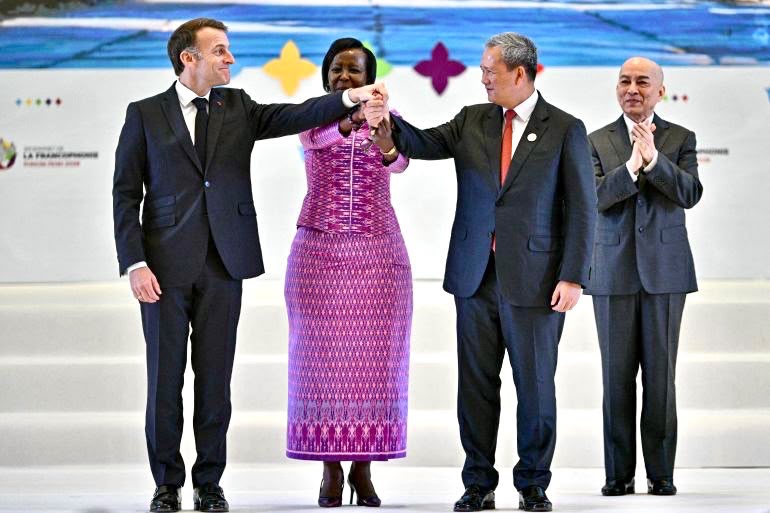
The 20th Summit of the Organisation Internationale de la Francophonie in Phnom Penh has closed without electing a new secretary general. What should have been a routine renewal of leadership turned into another public fracture between Rwanda and the Democratic Republic of Congo (DRC). Member states postponed the vote for a full year. Louise Mushikiwabo, the Rwandan incumbent since 2018, stays in place for the transition. Rwanda has agreed not to put her forward again when the process restarts.
Among the heads of state and senior officials who sat through the closed sessions, almost no one has spoken in detail about how the talks actually unfolded. Official statements stay carefully worded. Delegates who left the room have offered little beyond general remarks about the need for unity. People who were present prefer not to describe the precise exchanges that led to the deadlock.
Congo arrived with a clear line
Kinshasa had already made plain that it would not accept a third term for Mushikiwabo. The reason it gave was the same one it has repeated for years: Rwanda’s alleged support for the M23 armed group operating in eastern Congo. Rwanda rejects the charge. Congolese officials warned that a decision to keep Mushikiwabo would force them to reconsider their place in the organisation. With more than fifty million French speakers, Congo’s possible exit carried real weight for the OIF, already weakened by the earlier departure of Mali, Niger and Burkina Faso.
During the summit itself Congo shifted tactics
It withdrew its own candidate, Juliana Lumumba, daughter of Patrice Lumumba, and announced support for the Romanian former prime minister Dacian Cioloș. The move was presented as an effort to find a unifying figure. In practice it was also a way to isolate the Rwandan bid. After the postponement was agreed, Congolese Foreign Minister Thérèse Kayikwamba Wagner called the outcome a wise compromise reached after difficult discussions. Kinshasa treated the result as a success: the immediate risk of a third full term for Mushikiwabo had been removed, while its own candidate remains eligible for the next round.
Rwanda took the opposite approach
It refused requests, including from French President Emmanuel Macron, to withdraw Mushikiwabo’s name. Foreign Minister Olivier Nduhungirehe stated publicly that no member state has the right to instruct another to drop a candidate. He also criticised Congo’s backing of Cioloș, arguing that it ran against an earlier African Union preference for one of the African contenders. Mushikiwabo herself remained in the race until the end and later described the pressures on her as numerous and intense. She insisted the organisation should not become a venue for the bilateral dispute between Kigali and Kinshasa.
President Paul Kagame had travelled to Phnom Penh expecting that Mushikiwabo’s record and the support she had gathered in previous ministerial meetings would carry the day. He had rejected the idea of a pre-arranged consensus that excluded her. Once the talks began, however, the number of governments prepared to stand firmly with Rwanda proved smaller than anticipated.
Attempts by other African leaders to persuade him to step aside did not succeed, yet neither did a clear majority form behind his candidate. The result was not a vote that confirmed her third term, but a decision to delay everything. Kagame found himself with fewer public allies than he had counted on when he arrived.
The episode shows how quickly a regional conflict can travel into a multilateral setting. The OIF had long selected its secretary-general by consensus. This time the underlying tension between two neighbouring members made consensus impossible. France’s efforts to broker a deal revived older questions about the weight of the former colonial power inside the organisation.
Africa’s numerical strength inside the Francophonie did not produce a single African front. Instead it produced competing priorities, one of which was shaped by events in eastern Congo.
The one-year delay buys time, but it does not close the gap
When the next election is held, Rwanda has said it will not field a candidate. Congo has kept its options open. The organisation will still have to manage the same political reality that surfaced in Cambodia: two member states whose relationship is defined by accusation and denial, and a membership that prefers not to speak publicly about the precise way those accusations shaped the room.
The delayed vote has also given the Democratic Republic of Congo a fresh platform to highlight nearly three decades of war and suffering in its east, forcing the Francophonie to confront the same accusations Kinshasa levels at Rwanda. Both sides now have a year in which to choose dialogue over further confrontation and begin easing the tensions that have spilled into the organisation.