
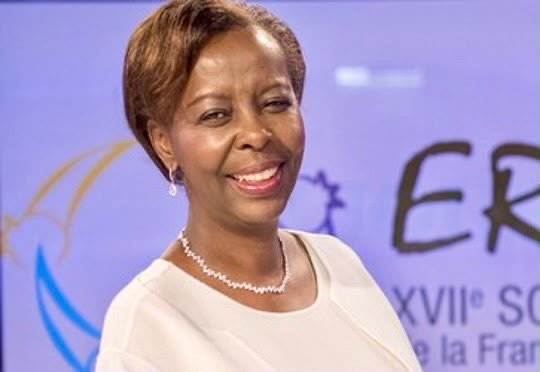
On 16 November 2026 in Phnom Penh, Cambodia, the Organisation Internationale de la Francophonie (OIF) will elect its next Secretary-General. Louise Mushikiwabo, who has held the post since 2019, is seeking a third term. That is already one term too many.
Four candidates are on the ballot. Rwanda’s Louise Mushikiwabo wants a third four year term after running the organisation since 2019. From a free speech standpoint inside Rwanda, that bid deserves sharp scrutiny rather than automatic applause.
Mushikiwabo, 65, previously served as Rwanda’s foreign minister under President Kagame. She has pushed administrative and budget reforms and expanded some youth digital training. Yet critics, including voices inside the Francophonie itself, describe her leadership as heavy handed and too closely tied to Kigali’s foreign-policy goals. Staff turnover and tighter control over programmes have left the impression of an organisation serving one capital more than 90 members.
Three Sahel states (Mali, Burkina Faso, Niger) walked out in 2025; she has not brought them back. Tensions with the Democratic Republic of Congo over eastern fighting also colour every debate about her neutrality. A third term would match the record of former Senegalese president Abdou Diouf. That precedent is not a strength. Organisations that recycle the same leader for a decade or more risk stagnation and the quiet capture of institutions by one government’s interests. Mushikiwabo herself once noted she was “not like Abdou Diouf.” Seeking the extra term now undercuts that earlier caution.
Her record on the French language inside Rwanda is especially thin.
After the 2008 switch to English as the main medium of instruction, French became a secondary subject. During her years as foreign minister and then as OIF head, classroom proficiency stayed limited. OIF has sent volunteer teachers since 2020 and Rwanda later adopted a national plan, yet most students still finish school with only basic or patchy French. One concrete example: many secondary-school clubs still struggle to hold simple debates in French without heavy coaching. Another: national exams long treated French as optional or lightly weighted, so motivation stayed low. A leader of the global Francophone body who cannot point to solid gains in her own country’s schools undercuts the organisation’s core purpose.
The other candidates bring different problems. Juliana Amato Lumumba of the DRC is the daughter of independence hero Patrice Lumumba and a former culture minister. She talks about a “Francophonie of the peoples,” stronger cultural industries and a bigger role for Quebec. At 70-plus she carries historic symbolism, yet her candidacy is widely read as Kinshasa’s counter-move against Kigali.
That risks turning the election into another front in the Great Lakes rivalry rather than a contest about language and cooperation. Her long absence from day to day Congolese governance also leaves questions about current networks. Coumba Bâ of Mauritania, a doctor and long-time presidential adviser, promises to prioritise the return of the Sahel states and better use of existing funds. She presents herself as a unifier. Yet her close ties to successive Mauritanian presidents raise doubts about independence from her own government’s priorities. Delivering on the Sahel return remains untested; previous outreach produced no breakthroughs.
Dacian Cioloș of Romania, a former prime minister and EU agriculture commissioner, stresses practical economic links, jobs for young people and stronger French presence in technology. Coming from a European member state outside the main African bloc, he can claim distance from regional conflicts. That same distance is also a weakness: many African members, who form the majority of the organisation, may prefer a leader more rooted in the continent’s daily realities. His insistence that he is not France’s candidate, has not fully dispelled the perception.
The OIF’s job is to serve ordinary French speakers. Students, teachers, small businesses and cultural creators, not to function as an extra diplomatic arm for any single government. Extending one leader’s tenure while French teaching at home stays incomplete and while regional splits deepen does the opposite. Member states still have time to choose competence and balance over continuity for its own sake.