

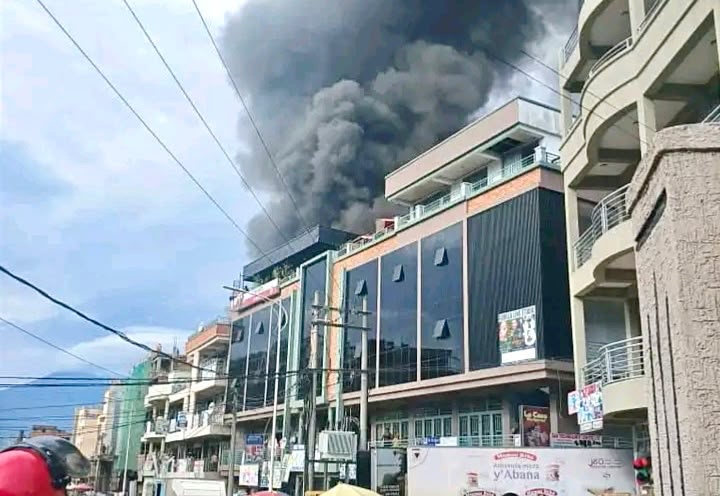
A large fire tore through GOICO Plaza, the main market in Musanze District, Northern Province, on Saturday afternoon, October 10. Flames started on the upper floors around mid afternoon and quickly moved through the five storey building. Thick smoke rose over the town as traders and customers rushed out. By evening the blaze had reached every level.
The market, finished in 2017 at a cost of more than 7.5 billion Rwandan francs, was built by 89 private investors under Gorilla Investment Company. It held over 1,550 traders and drew roughly 25,000 visitors a day. Banks, including a Bank of Kigali branch, insurance offices, shops and other businesses operated inside. People who spoke to Rwanda Freedom of Speech said they watched years of stock and savings disappear while the fire kept burning into the next day.
Some of those who had stalls or businesses there told us the firefighters arrived late and could do little because they lacked enough equipment and water pressure. They said the flames simply continued. Official numbers on deaths or injuries remain unknown. Authorities have not given a clear count, and many on the ground still do not know whether anyone stayed trapped inside.
Confusion hangs over the whole incident
No one has explained the exact cause. Reports vary on where it began. At the same time, insurance companies face fresh losses. Many traders had no cover at all, and those who did will now test whether their policies pay out after a total building fire. Ordinary people who sold clothes, fabrics, food and other goods lost the capital they had built over years. The 89 investors who put money into the structure itself also stand to lose heavily if reconstruction never comes or if claims drag on.
How a market that cost more than 7.5 billion francs had no real fire protection systems strong enough to stop this is already being asked in private. Some call it simple neglect. Others raise the possibility that the absence of proper safeguards was not an accident. Questions also surround the speed of the response.
Why did it take so long for proper intervention when the fire started in daylight in a major town? In recent years Rwanda has moved quickly into Burundi for security reasons even when budgets were tight. Yet here a major commercial building burned for hours with limited effect.
Residents ask why the same urgency was not applied at home.
Inside the market sat banks and other institutions. People expect that large amounts of cash or records may later be declared destroyed. That expectation only feeds talk about whether the fire could serve as cover for missing money. The same talk points to a pattern some see in how authorities handle big losses: the poor stay poor, investors become vulnerable, and ordinary traders start over from nothing.
Cunning delays and incomplete information leave people wondering if this is simply bad luck or a strategy that keeps capital circulating among a few while the majority keep struggling. These are not official findings. They are the doubts left after a building that should have been protected burned for so long.
Our condolences go to anyone who lost their life in the fire and to every trader and family whose goods and savings are gone. The number of lives lost is still unknown, and the full cost is only beginning to show. As long as more updates reach us we will publish them.
Our Voice. Our Freedom