

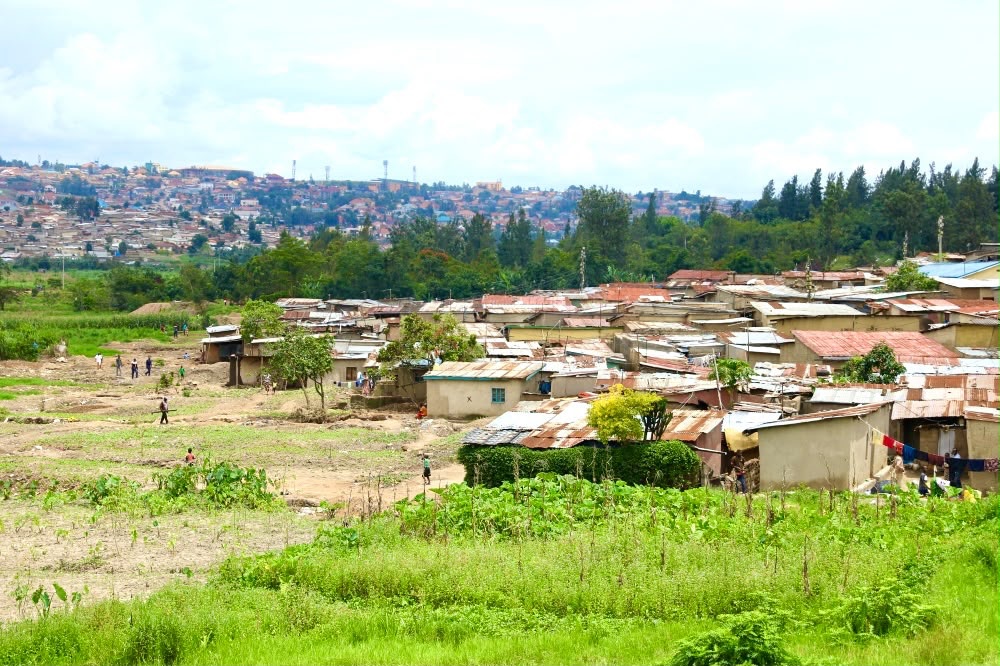
Kangondo and Kibiraro sit in Gasabo District, in Nyarutarama cell, next to one of the richest parts of Kigali. For years the two villages were known together as Bannyahe. Roughly 1,500 families lived there in houses they had built themselves, some small, some with several rooms, on land that became valuable the moment the city decided the neighbourhood had to go.
From about 2017 the City of Kigali told them to leave. The offer was not cash at the price a buyer would pay on the open market. It was mostly a finished house in Busanza, in Kicukiro, far from the jobs, schools and customers they already had. Hundreds refused. They said the valuation of their homes was too low, that a house worth more than ten million francs on paper could not buy anything decent in the city, and that a ready-made unit was being forced on them instead of agreed.
In September 2022 police sealed the settlement. Drones told people to move. Caterpillars took down houses. Residents told the BBC they were being cleared so the prime plot could go to investors. Officials said it was city planning, public interest, and safety in a wetland and a flood-prone zone.
Named residents, among them David Munyeshuri, Jean de Dieu Shikama and Emmanuel Sahinkuye, sued the city. In April 2024 the High Court said some of the families already moved were entitled to money, not only the house they had been handed. The argument was never that Kigali has no right to plan. It was that the people on the land were priced out of their own neighbourhood.
Later, Shikama Jean de Dieu was sentenced to prison for genocide ideology and denial after, as a Kangondo-Bannyahe spokesman, he called the forced eviction and under-compensation a genocide, while fellow spokesman Jean de Dieu Ihorahabona who had already been briefly detained in 2022 over the same land fight has been missing since 1 February 2026, when witnesses say men identifying as police took him near his daughter’s school and authorities have issued no arrest record or charges.
The law is clearer than the practice. Law N° 32/2015 says only the state can expropriate, and only for a public interest project.
Fair compensation is the market value of the land and what stands on it, plus five percent for the disruption. It can be cash, or another form, but only if both sides agree. It is supposed to be paid before anyone is told to move. After payment, the owner has up to 120 days to leave. If the money is not paid in time, the expropriation falls unless the owner accepts a delay. A person who rejects the valuation can bring their own valuer and go to court.
Foreign investors are part of this whether they mean to be or not
City officials have said the new estate was built by investors and that residents had to move for planning. Plots cleared in Nyarutarama are the kind of land a developer wants. If the family that lived there was underpaid, or still in court, or missing, the buyer of that plot is not a neutral customer. A title that looks clean at the land office can still sit on an unpaid claim. Anyone taking land the state has just emptied should ask who was on it, what they were paid, whether a case is open, and whether the public interest project on the approval is the project that will actually be built. If the answer is thin, walking away is cheaper than becoming the name on the gate.
The damage is not confined to one hill in Gasabo. Expropriation for roads, wetlands and new urban plans runs across the country, and the state has paid out large compensation budgets on some projects. The wound is where the payment is late, small, or replaced by a house the owner did not accept, and where asking for the difference brings arrest, abduction, imprisonment, or silence. That is how a housing programme produces people with nowhere stable to sleep.
What can you do
A unit in Busanza without a solid title is not the opposite of homelessness. It is homelessness with a door.
If your land is tagged, write everything down. Keep the land title, the valuation, photos of every room, and the names of the officials who visited. The law gives you seven days after the approved value to object in writing, and a path to your own valuer and to court.
Do not sign a relocation paper you do not understand. Speak to a lawyer before you take the key to a replacement house, and ask whose name will be on that title. If you are told the plot is a danger zone, ask for the map, the flood record and the date the label was applied.
For the buyer/Investor
If you are buying, do not trust a fresh title on a cleared site. Ask the neighbours who left, check open cases, and walk away from any seller who cannot show that compensation was agreed and paid. A cheap plot in a former settlement is often cheap because someone else is still claiming it.
The state can move people for a real public work
It cannot do it at a fake price, with police at the gate, and with the spokesmen of the displaced missing. Courts have already told the city to pay some of these families in money. The next test is whether Ihorahabona is produced, whether Ntwali’s death is investigated by someone who does not answer to the same chain of command, and whether the cleared plots are sold only after every claim on them is settled. A capital that looks finished while the old owners are in court, in a one room house or nowhere, will not stay quiet.
Investors will price the risk. So will the families who still have a case number.