


A man leaves home after a Gacaca sitting. His wife is told he will break stones and come back. Months pass. Then years. The children grow up with a name and no grave. That is not a film plot. That is how many families remember TIG.
TIG means Travaux d’Intérêt Général. In simple words: work for the country instead of a long stay in a cell. In Rwanda, it started in 2005. The idea was good. The way it was run was not always good. This article is a warning. The government should not repeat the same rush, the same silence and the same habit of locking people first and thinking later.
What TIG was supposed to be
After the 1994 Genocide against the Tutsi, the prisons were full. Gacaca courts tried a huge number of cases. For people in the middle groups who confessed, part of the sentence was unpaid public work.
The state said TIG would cut prison crowding, rebuild roads and houses and help people return to normal life. Official reports later said more than 50,000 people were sent to TIG. They cut millions of paving stones. They built classrooms. They put up thousands of houses, some of them for the genocide survivors. The Rwanda Correctional Service said the labour was worth more than 40 billion Rwandan francs that the treasury did not have to spend on prison walls.
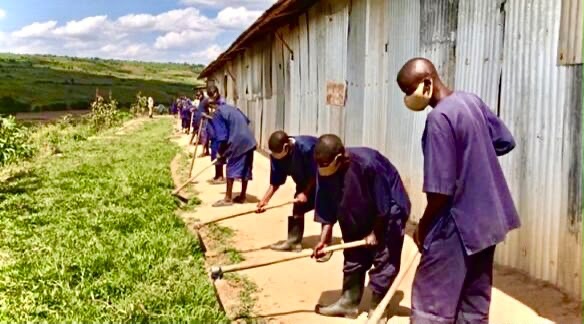
Those numbers are real. A lot of that work happened in closed camps, not on the hill where the person lived. Some people slept at home three days a week. Many did not. They crushed rock, they carried stones. Old men were in those lines. Food and beds depended on the district.
Files moved from camp to camp

Families often could not follow the paper. Who ran it? The then Justice Minister Edda Mukabagwiza launched and defended TIG. In August 2006 President Kagame removed her from cabinet. No full public audit of the camps came with that change.
Later, the day to day voice of TIG was Evariste Bizimana the programme coordinator, not a minister. After 2012 the work sat inside the Rwanda Correctional Service. General Paul Rwarakabije, then commissioner general, denied stories that hundreds of tigistes had vanished. He said people changed camps and the records were poor.
Poor records are not a small thing. If the state cannot show who arrived, who was moved, who finished and who died, a family has nowhere to stand.
Among the names families still say in a low voice is Colonel Charles Musitu.
Musitu was an RPA officer. He commanded the 21st Battalion that came down from Byumba toward Kigali in 1994. He left the army in the late 1990s while still a colonel. In the TIG years his name became tied, in popular memory and in exile writing, to the running of work camps.
In May 2021 the website The Rwandan, published a piece whose title asked, in Kinyarwanda; why Colonel Charles Musitu slaughtered the tigistes. The page carried his photo and a video. The state never answered that charge in a public inquiry with names, dates and medical files.
This newspaper cannot treat that headline as a court verdict. It also cannot pretend the accusation does not exist. Families say people under harsh camp command were beaten, overworked on the stones, denied decent care and in some cases never seen again. A colonel is not above a count of the living. The government still owes that count.

Mugina and the stones
Mugina in Kamonyi is first a genocide site. Tens of thousands of Tutsi were killed there in 1994. That history is not in doubt.
Stone breaking as TIG work is also not in doubt. Early camps at Nyanza and Ruyumba put hundreds of people, including men over sixty, on rock piles to make paving stones for Kigali. Other sites followed the same pattern.
What has not been published is a clean official list that says “this many people served TIG at a Mugina quarry and this many died there.” Families who say a relative was sent to break stones near home and never returned should not be told to keep quiet. They should get a paper trail.
Why filling prisons first is the wrong policy? Look at the budget.
In one published finance annex, the line for inmates and tigistes social welfare set aside about 7.2 billion francs for food alone in a single year. That is only food. It does not count buildings, uniforms, water, guards, medicine and transport.
Rwanda has still held more than 90,000 people in correctional facilities in recent years. At one point crowding passed 140 percent of official capacity. It has come down toward 100 percent, mainly through plea deals, mediation, a new prison, and some releases. Senators themselves said the economic cost of feeding so many people is the part the public does not see.
Now look at the family
When a parent sits in a cell before trial, the field is not tilled. School fees stop. A wife walks to a distant prison with a small amount of cash. Children learn the road to the gate, not the road to a classroom. A suspect who later walks free has already paid with months of lost work. The state paid too, for a bed that should not have been filled.
The law already says a suspect normally stays free during investigation.
In the 2024–2025 court year, judges still ordered detention in about 63 percent of pre-trial cases. The exception has become the habit.
Bail should be the better first tool
Bail is not a gift to criminals. It is a way to keep a person available for court without making the taxpayer and the children pay for a cell.
Rwanda’s procedure law already allows conditions: stay in one area, report to an office, give up a passport, put down money, wear a monitor. Senators have even asked for more ankle tags. Use them.
Give bail as the normal step for offences that are not violent and not a clear flight risk. Keep prison for people who are a danger, who have destroyed evidence. If a person jumps bail, then arrest. Do not arrest first and invent the reason after.
What RIB and RNP must change
The Rwanda Investigation Bureau and the Rwanda National Police are judged, too often, by how many people they lock up before investigation is completed. That is a bad scoreboard. A good scoreboard looks like this:
- How many files were ready before an arrest.
- How many suspects were left at home with conditions.
- How many 72-hour holds actually ended at 72 hours.
- How many RIB lock ups were empty enough that a mother could find her son the same day.
- How many officers were punished for holding someone with no charge.
Arrest should be the last tool, not the first show of power. Night raids for small cases, long stays in station cells and investigate while he sits are how TIG era habits leak into ordinary crime work.
Train officers to collect evidence first. Train prosecutors to ask for release with conditions. Publish monthly numbers of arrests versus summons.
How to run TIG well this time
Work near home whenever the person is not a danger. Three days a week is enough for many cases. Camps should be rare, short and inspected.
Every tigiste gets a file the family can see: start date, site, transfers, health visits, end date.
Work matches the body. An old man does not spend a year on a quarry hammer.
Food, water and a clinic are written into the contract with the district. If the district fails, the person goes home, not to a worse camp.
No unpaid quarry for people who were never fairly tried. Review the old Gacaca to TIG lists where families still swear the name was wrong.
The benefit of good TIG is not a speech. It is a road that exists, a house a survivor can sleep in, a person who still feeds his children at night and a treasury that is not buying beans for 90,000 idle mouths. The lesson the cabinet should keep on the table
TIG was born from a real emergency
Prisons could not hold everyone. The country needed labour and a path back to the village. That emergency is no longer an excuse for closed camps, missing lists and a colonel whose name still frightens families.
Do not decide a mass penalty in a small room again. Talk first with survivors, with churches, with lawyers and with the people who will cook for the camps. If the policy cannot survive that talk, it is not ready.
Put suspects in prison only when the law truly requires it. Use bail. Change how RIB and RNP count success. Keep TIG, but keep it in the open, near the family, with a name on a page that a widow can read.
A government that feeds tens of thousands of waiting men while their fields go to bush is not showing strength. It is showing that it has not learned.